Tuesday, April 24, 2012

Back to Basics

I’ve been pontificating about graphic communications here for the last couple of entries, taking a stab at getting clients (and potential clients) to read the blog. This, however, does not seem to be happening. So, while I’ll be talking a bit about business, I’ve decided to revert to making this a location for friends and family to keep tabs on what I’m up to these days.

The business has begun to take off. My billable hours have been increasing slowly each month, and I’ve even made the first of my quarterly income tax payments. And while still far from being a burgeoning fount of plenty, running my own business is turning out to be a very interesting experience. The biggest challenge is keeping motivated at marketing and finding ways of advertising myself that are cost-effective (that is to say, nearly free) and that produce results in the form of new clients.

Primeval Redwood Forest at Elks Prairie
I’ve got my Facebook page up and I’m adding to it. I’m only eight “likes” away from having metrics added to it, which will allow me to keep track of visits and such. It’s kind of a long-haul thing, and I don’t expect to have the complete knack of this social network marketing for quite a while. Included on the page here are the three different “flavors” of cover pictures for the page. I swap them out every week or so to keep things looking fresh. I also have a Photoshop template I can use to take more of my own photographs and turn them into cover shots for the page.

I have subscribed to AdWords on Google, which puts me up front thousands of times a week when someone in my area googles things such as “graphic designer.” The placement is free, but if someone clicks on the ad, then I get billed. In the 10 days since signing up, I’ve gotten almost 60 clicks (which sends people to my website) and four actual calls or e-mails asking about my service. So far, none of those has turned into an actual job.

Central courtyard of the Louvre in Paris
Steve kept pushing me to get onto Angie’s List, so I signed up there and got Pearce Plastics to post about how nicely I’ve done for them. Yesterday, I got a call from a woman who looked me up on Angie’s List and wanted help getting a website uploaded onto a new host server. I was honest and told her she could do this herself and she replied, “Yes, I know, but I don’t want to.” So this afternoon I’m going to drive to her house in Alhambra and upload her website (actually for a nonprofit corporation called International Music Initiative, or something like that) and get her set up on the new server.

If someone would have told me in college that I would spend the afternoon uploading a website to the Internet, I would have said, “Do what to what on the what?” I took computer programming classes in college, but we put the programs and data sets on punchcards and left stacks of them, bound with rubber bands, in piles in the computer lab. They got fed through the monster IBM computer at school and a printout issued at the other end, usually with several fatal errors in the coding, which required fishing individual cards out of the stack for corrections; then the whole thing would get a new rubber band and go back into the pile. You were lucky is you saw your results in two days.

Now I’ve got a computer sitting on my desk here and a laptop I use for client meetings in the field, each of which far outstrips that old IBM monster in power, speed and capacity. Of course, that was thirty-some years ago.

A cloudy day at Frank Lloyd Wright's Taliesen in Wisconsin
Tomorrow, I’ll be getting my hair cut and pitching a website to the salon owner at the same time. Madeleine, one of Steve’s at work, found out her hairdresser was thinking of putting up a website, and she suggested me. I called the guy a couple of times, but he was always too busy to talk, so I made an appointment for a haircut, figuring we’d have to talk, and my mop top is getting a little shaggy in any case.

I had a meeting yesterday with a gentleman who wants to redesign some packaging for his business. It’s not a huge job, but one that might extend, if his product catches on. I had arranged to meet with him at 4 p.m., and I was on my cell phone talking with the woman who I’ll be meeting with today when the office phone rang. I had to put her on hold while I answered the office phone and adjusted the meeting time for that afternoon to 4:15.

It was such as rush to actually have two phone calls going simultaneously, like a presage of a busy business a few months down the road.

Steve’s doing well. His job runs from mundane to insane, depending on what’s happening on any given day. He’s only a couple years away from retirement, and I think he looks forward to being able to gear back, take a part-time job and enjoy life a little more. My goal is to have a solid studio running with a healthy income by the time he hits retirement, and I think that viable and possible. From what I’ve heard at chamber meetings and mixers, the first year of a business is the toughest. After that, you start getting a sense of the pace and flow of your work, and word starts to get around about what you have to offer.

One problem I’m having is trying to connect with other designers in the area. The few that belong to the chamber of commerce were pleasant enough, but one woman was downright paranoid when I approached her. I’m not sure whether they think I’m going to steal customers or take trade secrets or something, but I think it would be great to have a group where we could discuss what works for you, what doesn’t work for you, and experiences with clients in general. Let’s just say no one has been enthusiastic about the concept when I’ve brought it up.

Whatever. I figure there’s plenty of work out there for good designers, especially those who know web design as well as print. And even though there’s a lot of do-it-yourself design sites online (see my previous entry titled “The Tyranny of Themes and Templates”), I think most savvy business owners know that putting out the money for a professional designer is worth it. And, even on my first meeting with a potential client, one of the items I focus on is ways to save money while getting good, comprehensive design for their dollar.

So I continue. Running your own business really is a day-by-day thing. But, then, so is life.

Friday, April 13, 2012

The Tyranny of
Themes and Templates

Just like you have an accountant and a lawyer for your business, it’s important to have a graphic designer who’s there to help you on a daily basis with your business’ marketing and communication needs. A designer can help you avoid the pitfalls of the labyrinth of modern communication options.

The last few decades have seen an explosion in visual mediocrity. The avalanche of visual stimuli that assaults us on a daily basis is astounding, and growing; we react to it by becoming numb. The marketers’ respond by putting more flash and pop and sex and action into the content without any good reason other than making us look. Clever computerized graphics get ever more real — and surreal — and we become accustomed to casually watching animated images that used to be perceived as delusions or hallucinations. And we get even more numb.

But perhaps the most diabolical and banal of actors in this visual overload are themes and templates. Do you have Microsoft Word? You have themes and templates. Use Quickbooks? They're there, too. Every document-building program has them. You also can go online to any do-it-yourself print or web design site and find them: Pick from half a dozen color schemes, choose from hundreds of templates (most ranging from ugly to hideous), pick from 10 or 12 typefaces, add your own picture and a personal message and, presto: instant design for business cards, stationery, brochures, return address labels, etc., etc.

The resulting collateral looks nice enough, and it has the information you want, but it says nothing about you or your business, your vision of what your goods and services can provide: Instead of motivating your potential and repeat customers, you are supplying them with more numbing imagery. Not only that, you’ve now joined the masses who settle for meaningless visual mediocrity, and that’s what’s communicated to the public. You may have saved some money, but you’ve dedicated yourself to a bland visual image for a long time, because you’ll have to use up all those business cards and all that stationery before you have a chance to change your mind.

Like any professional, a designer is trained to find out about you and your business, he or she gets to know your personality and your outlook and how you approach working with your clients or customers; it’s part of his or her job. A designer can synthesize all that down to a unique visual solution that will fit you and your business' needs, and create a meaningful core identity for your communications with the public.

Another important point when choosing a graphic designer: you want to find someone who can create a seamless match for that visual image across all of today's communication platforms, from print to website to social networks. Find out if your designer builds your website from scratch or, instead, uses services like Wordpress or Drupal or Joomla. All these services are theme-based or template-based. And while lots of themes are available, they result in the same banal visual bromide as other prefabricated media design: Choose this theme, add this and that plug-in, change a color and a typeface and you’ve got a website.

A good graphic designer can provide thousands of color scheme choices, tens of thousands of typefaces (in print and online), and deliver a one-in-a-billion visual solution that will match you needs and be memorable in the public’s mind. Also, if you have specific interactive needs for your website, like online shopping or reservations, a good designer has the resources to create that functionality with your business in mind. And a good designer will work within your budget to create a unique identity and collateral that will grow and change along with your business.

So, revolt against the mundane. Look around and find a good designer to add to your list of business advisors. Because the visual image you present to the public should be as unique and important as you and the goods or services that you supply.

Monday, April 9, 2012

Suspension Bridges of
Madison County

Design is the process of creative problem solving: Because it is about solutions, it’s a practical process; because it is about creativity, it’s an aesthetic process. It’s not always easy to get these two aspects moving in harmony without letting one or the other take over. The practical requires logic, hard information and numeric accuracy. The creative requires subjectivity, critique and emotional evaluation.

I think everyone can agree that the Golden Gate Bridge is great design, even timeless. It is the marriage of an engineering feat with an aesthetic design perfect in scale and proportion. It achieves the solution of providing passage over the inlet of the San Francisco Bay while providing room for the shipping lanes below, and it is breathtaking to behold.

But say you’re a rural town of 30,000 people and you have to build a bridge over a 100-foot wide river flowing through your community: building the Golden Gate Bridge or anything like it would be absolutely ludicrous. That’s because, although both are bridges and both address spanning a course of water, the problems are also very different in their scopes and environments and the needs of the communities they serve. The rural community has to approach its problem as unique, and the design it ends up constructing may be as or more beautiful than the Golden Gate, but only if the bridge solves the problem both practically and aesthetically for its community and its course of water.

Shift over to graphic communications and apply the same concept: the practical aspect of a graphic communications design solution is getting information transmitted effectively (and cost-effectively) to a target audience. If you’re a local business that relies on your community to purchase your goods or services, it doesn’t make a lot of sense to produce a national television ad campaign. The commercial spots might be visually stunning and wildly creative, but you’re wasting your money delivering an extravagant spot to an overly broad audience when good design (practically and aesthetically) dictates targeting local neighborhoods with locally relevant information. You will have wasted a lot of money sending the wrong message to the wrong market.

Many businesses make this same mistake when approaching their website design. A retailer may look at the website for a national department store and want to emulate that, but the amount of purchasing traffic that will move through a local website may not even warrant an online shopping module. Also, purchasing elaborate third-party online services can be a mistake, since most are sold “packaged” or “bundled,” and you may get charged for a lot of services you’ll never use. Before letting your emotions and subjective decision-making take over, look at what communication functions your website will shoulder best, then budget and design around those needs and strengths.

One big responsibility for a designer is making sure the client doesn’t skew too far away from his or her main goal during the design process. The toughest thing a designer has to do is inform the client that his or her ideas or concepts are going in the wrong direction, or that the client’s decision is not using the marketing budget effectively, no matter how large the funds at your disposal are. If you’re working with a good designer, trusting his or her advice can be the first step to running a lean, clean promotional machine.

After all, communicating with local markets is about developing personal relationships with your local customers; finding ways to cultivate and motivate those over time. No matter how high-falutin’ the technology gets, it’s still word-of-mouth that get customers and clients through your doors and onto your books. It may show up as posts on Facebook or Tweets on Twitter or reviews on Yelp or other social rating sites, but it all comes down to people trusting people who say good things about what you do.

Even here in the 21st century, local marketing still comes down to generating backyard gossip and water-cooler buzz, even if it is taking place in cyberspace.

Wednesday, March 21, 2012

Like, Follow, Poke, Pin, Tweet, Share

Folks of a certain age will remember receiving bills in the mail in the form of a perforated punch card. This was back when computers were at least the size of an old Buick and data was fed into them via electromechanical means (punch cards, perforated paper tape and the like). Somewhere on those mailed bills was the phrase, “DO NOT FOLD, SPINDLE OR MUTILATE.” If you did, it meant the auto-reader device could not translate the data on the card, and they would have to be input by a human.

This was the beginning of the end, though we did not know it at the time. We were being asked to adapt our behavior for the convenience of a computer, a machine. Resistance was futile.

We now live in a world where corporate entities (which some try to convince us are humans) do their level best to keep people from connecting with people. On the phone, on the Internet, a communications technology has sprung up to distance the consumer from the provider. It can be a numbered multiple-choice scheme or a voice-activated multiple-choice scheme, but try to talk to a human being and you are thwarted at every turn.

This, in and of itself, is reason and motivation enough to patronize local small businesses, because they don’t have the deep pockets it takes to set up these technological walls of semi-communication. And why would they want to? Local businesses yearn to make contact with customers, they are preoccupied with making connections on a personal level, they are constantly searching for a way to bring you into their stores and provide you with the best goods and services they can. Local business is in the business of being personal and personable.

Folks of a certain age will also remember what avenues small business had to market their wares in the previous century: There were local newspaper and magazine ads, targeted postcard and brochure mailers, door-to-door handouts and the occasional poster; maybe sponsor a Little League team and, if you had the money for them, radio spots were hot with the kids. Back then, “networking” was something that TV stations did to get their primetime programming, and businesspeople joined local organizations as much to benefit the community as to promote their own enterprises (luckily, to a large extent this is still true).

But the faster things go, the more interconnected we get, the more aggressive and indifferent the competition from huge corporate entities becomes, the more frantically small businesses look for ways to make their marketing work in this brave new cyberworld. In order to keep up with the technology of corporate competition, viral marketing has become the domain of small business. The upside is that it’s really cost-effective; they downside is it requires more attention than mailing postcards.

First, having some kind of presence on the Internet via a website is crucial. Your website is your calling card, your brochure, the first face that most consumers see when they check out your business. Getting potential customers off their keisters and into your store can be a challenge, though, so many businesses look to online retail as an alternative. Unfortunately, that can be costly and time consuming, and why sell online to people who live just around the corner or down the block? While cyberselling may turn a buck, it doesn’t enhance your customer base as effectively as face-to-face encounters.

For direct consumer marketing, social networking is the mode du jour. Everyone, it seems, is tweeting and following and yearning to be followed and poked and pinned: we all have our pages on Facebook and “like” our “friends” so that they'll “like” us back. On Pinterest, you can show off your wares and preoccupations to the globe. But, as with any other marketing strategy, social networking only works if you apply yourself consistently, and if you provide your “followers” and “friends” with content that is not only relevant to your business but of genuine interest to your target audience.

Avoid touting pseudo-sales and spewing empty self-promotion; your tweets and posts are easily blocked. Instead, spend some time trolling the Internet for information your target audience would find as interesting as you do. Share and tweet that, and friends and followers will share and retweet it with their own circles: that's how your name goes viral, and that's how you build your online audience base.

A third, and potentially most effective cyber-marketing tool is e-mail blasts. In most cases, this is a nice way to say “spam.” If you’re like me, you spend more time unsubscribing to these irritants than you do actually reading them. But, if done properly, e-mail blasts can be a real plus to your business.

The e-blast Golden Rule: Only send out e-mails when you have something of value to say: they are communiques, not ads. A good e-mail campaign will show up two or three times a month at the most (let social networking be your daily audience informer). E-mails should have real news, engaging writing, and worthwhile visual content and no manufactured promotional hype. Make sure to add links back to your website and social networking sites so you can further engage an interested reader, and always, always make unsubscribing obvious and one-click easy.

Use Google Analytics (or other data services) to track your online presence and adjust your strategies accordingly. And remember, online marketing takes time to grow. Provide consistent value in the information you provide, and a trusting and loyal audience will be the result.

The biggest advantage you have as a small business is that you can use all this high-tech crap to connect on a personal level. If you see that a valued customer has unsubscribed to your e-mail, you can call them in person and show your concern. If you get negative feedback on Facebook or Twitter, you can send a personal e-mail and start a one-on-one dialogue that might just open your eyes.

Now, as it ever was, local businesses need to focus on their strengths: we’re selling to our neighbors, we’re developing commercial relationships that are genuine and trustworthy and, hopefully, will last for decades, even generations.

Good communications technology is technology that promotes authentic human interaction, and that only happens when we invest ourselves, more than our bandwidth, in the process.

Thursday, March 15, 2012

Where, There and Every Here

Yeah, so it's been three weeks since I made an entry. I've been kind of busy.

You may recall the last entry was on the day I submitted my mailing at the post office. Well, the next day, I got two phone calls from potential clients. One's a well-established beauty salon here in town and the other is a private mental health-rehab hospital, also here in town. Out of the gate, I did a poster for the salon (for a charity auction they were donating to) and a redesign of a flyer for a seniors program for the hospital.

I've also been spiffing up and expanding on my contact database, which is now almost 900 entries. Then there's folding another 500 brochures and pasting 500 cards inside them, joining the Pasadena Chamber of Commerce, revamping my website with more pages and information, and finalizing the custom designs for my business forms in Quickbooks.

I also have been developing my business page on Facebook and my Twitter site. Facebook has been somewhat of a challenge, since I had just gotten the hang of working with the page and they rolled out an entirely new look and format, so it was back to the drawing board (digitally speaking) to come up with a new look for the page.

Big treat for me on Monday of this week: my sister-in-law Pam was in town (well, Laguna Niguel in Orange County, which is just down the road, in Southern Californian terms) with her friend Connie, visiting their friend Marcia. So the three women and I got together in downtown Hollywood for lunch.

I picked the Pig & Whistle for its authentic 1920s crazy Hollywood pseudo-Moorish architecture, and because they have an excellent shepherd's pie. It also allowed them to see the stars on the sidewalk (the Hollywood Walk of Fame), check out the Kodak Theater (which Billy Crystal dubbed the "Chapter 11 Theater" at the Oscars ceremony) and see the footprints in cement in front of Grauman's Chinese Theater.

I hopped on the Gold Line light rail here in Pasadena and transferred to the Red Line subway at Union Station to head out to Hollywood and Highland. The women, who had spent the morning at Venice Beach (at Pam's request, I understand), arrived at lunch around 1:30. We had a wonderful time. I had the club sandwich and a vodka collins. I can't remember what everyone else had (though no one had the shepherd's pie), but I do remember the conversation was scintillating.

The next highlight of my week was my first social/networking mixer as a new member of the Pasadena Chamber of Commerce. It was held at Mijares, the oldest restaurant in Pasadena (and really good Mexican food). I got to hand out six or eight cards and mingle with a dozen folks or so. It went fairly well, considering that walking into a roomful of strangers and striking up conversations is one of the things I hate most. My reward was ordering a couple of their "garbage" burritos to go and bringing them back home for dinner.

The one thing I haven't gotten the hang of yet is trolling the Internet to find interesting things to tweet about or post on Facebook. And I also want to expand my links page, because there are so many interesting sites on the web having to do with typography and design.

So, all in all, things are going well. In less than a month I've gotten two clients (my goal is 12 by the end of the year), and I've started networking both online and in reality. Keeping the conversations going and sprightly is my next goal. And posting relevant, profound and astounding things here on the regular basis, of course.

Of course.

Friday, February 24, 2012

Going Postal

For over a week now I have been preparing a bulk mailing to introduce Mark McD design to Pasadena businesses. Being on a tight budget, I decided to do everything myself.

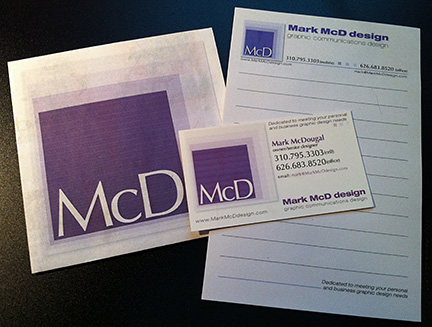
Of course, I designed my brochure and my business cards and my return address labels. I put in a 4”x6” pad of sticky notes with my logo and contact info, and loose-glued into each brochure was a business card. I was pretty happy with the package as a promotional piece, and I’m hoping that at least one person who received it has come as far as to check out the blog page (which is linked to the redesign of my website). If you have, I’d really appreciate it if you could leave a comment (see how-to instructions to the right).

Now, if you take a look at the inside graphics of the brochure and go to the website on your computer, you’ll see a Flash animation of the graphics on the intro page. (If you go there on your mobile device, there will only be a static image, since most don’t support Flash.) And with the redesign of this blog page, I think the branding consistency is pretty good. Hopefully, concentric purple squares will soon be burned into many heads here in Pasadena; I know they’re burned into mine.

So my days have been filled with adhering 500 business cards inside 500 brochures, stuffing 500 envelopes with brochures and sticky pads, sealing the 500 envelopes, applying 500 return-address labels, generating a 500-name mailing list, printing and affixing 500 address labels. Little did I realize that the fun was only beginning.

Actually doing a bulk mailing is much more complicated than I thought. Had I known then what I know now, I would have coughed up the extra 25 bucks and sent everything first-class mail. (the per-piece price for bulk mail is cheap, but the $190 annual permit is not.) I figured, though, that I might want to send out a mailing of postcards or some such in the next year, and having the permit already would make sense.

I went online to the USPS website and researched what I had to do. I had all my mail presorted, lowest zip code to highest zip code, and went down to the post office.

My first adventure was getting directions from an employee in the front lobby, who said the bulk mail section was “around the corner of the building at the blue gate; just push the button.” Following these directions, I ended up sitting in front of what is the employee parking lot, which has no buttons at all.

I had not had the presence of mind to put the phone number for the bulk mail center into my cell phone, and the main line for the post office was constantly busy, so I went home and found the bulk mail number, put it into the phone, called and found out that I had been sitting at the wrong gate (there are three blue gates at the post office).

Day two of my adventure: I headed back down with my presorted mail in clearly marked boxes, found the correct gate and marched in to get my permit and mail my bulk. This is when I found out that I had to arrange my mail in authorized USPS letter trays and separate out local zips (910, 911 and 912) from non-local zips. Also, I either had to pay an extra $190 for a preprinted bulk mail stamp (which meant ordering a rubber stamp with my permit number and waiting for it to get to me), sign up for a very expensive private postal metering service, or purchase bulk rate presorted stamps and affix one to each of the 500 envelopes. The budget dictated I go for the stamps.

Now these specific stamps come in two quantities only: rolls of 500 and rolls of 3,000, and they cost 10 cents apiece. The rolls of 500 are gummed, and you have to lick them, while the rolls of 3,000 are self-adhesive. Once the stamps are affixed to the bulk mail piece, their cost is deducted from the overall price of the mailing costs, so they’re basically free. So I grabbed three trays on my way out (at least the permit had been paid for), then headed to the front lobby to purchase the necessary stamps.

That afternoon and evening was spent removing all the mailer pieces from the boxes, licking and affixing 500 stamps, then placing the letters, numerically sequenced, into the trays. I stacked them on their sides in order to accommodate two rows in each tray so that everything would fit.

Day Three through the bulk mail looking glass: I proudly took the trays down and presented my completed form (downloaded from the USPS website) at the bulk mail desk. The woman there informed me that I had to put the letters in the trays topside up, and that the trays had to hold only one of the three-digit zip codes: 910, 911 or 912. All others zips that fell outside those local codes could be placed together in a separate tray, being charged at a higher rate.

Once the trays were properly separated and filled, each had to be slipped inside a cardboard sleeve and transferred to a hopper for weighing. Finally, one piece picked at random had to be opened and inspected to make sure the contents met the criteria for bulk mail (like no invoices or bills allowed, among other restrictions). When the woman opened my piece, she seemed very impressed with the brochure and the sticky pad (especially one so large). Once all this was done, I had to return to the front lobby and get a metered strip and pay the balance of the mailing fees.

You would think by now I would be foaming at the mouth or in a rage, expressing the true meaning of “going postal.” But to be honest, I was having fun. The woman at the bulk mail office was patient and friendly, and even helped me sort out my pieces, and I have gained a new appreciation for what, exactly, it is you pay for when you hire a mailing service.

So, I close with this photograph of myself. It was taken just after waking up in the morning, but it is a fairly good interpretation of how I felt after the mailing was out and done. But you know what they say: “That which does not kill us makes us stronger.” For practicality, I think “or crazier” should be amended to that statement of wisdom to make it a touch more accurate.

Wednesday, February 8, 2012

Branding Frenzy

You may have noticed a change in the look of the old blog page here. Well, it’s all part of my excursion into a place I like to call Branding Land. It’s odd, but marketing my own business is a crash course on how to market other people’s, as well.

The biggest part of my recent work has been redesigning my website, which had to be reworked for potential customers rather than potential employers. It’s clean and simple, and I think it will do the job. Also, on the “about” page, there is a link to my portfolio website (which has not been rebranded … yet).

Yes, as part of starting up the studio, I have been immersing myself in all kinds of marketing information, both traditional and e-marketing. Beyond reworking my website, I have also built a business Facebook page for the studio, and have even joined twitter (a social networking site that has always eluded me). Both are now linked to every page of the website because you have “to be where your customers are,” according to the latest viral marketing information. I did stop short of putting them on my business card and brochure, since the cybersavvy customer will check out the website first, anyway.

So I’m spewing my logo around cyberspace, as soon I will be spewing it around town via a mailing and handouts of my brochure. Each brochure will have a business card inside, stuck with removable glue, and each mailer will have a 4”x6” promotional sticky pad (the biggest sticky I could find).

The brochures and cards should be ready at the printers tomorrow, and the return address labels (also branded!) will be coming from a production house (because I could get them half-price online). I already have the sticky pads and specially sized envelopes to house all the pieces. When everything comes together, there will be a flurry of unfolding, gluing, refolding, envelope stuffing and label sticking around here.

Once the mailing is out, I plan to walk each area of town and hand out brochures in person, meet the small business owners in the area and get their business cards to add to my database. (I started building it about two weeks ago and now have over 800 entries with business names, contact names, e-mail and mailing addresses, and phone and fax numbers. I probably have another 200 or so to add before I start my canvassing).

So, I’m seeing nothing but purple squares, and tints and tones thereof. I’ve been working with these images for so long, that I’m starting to get visually numb to them. I’m hoping they will make a good first impression on those who haven’t seen them yet. And, hopefully, they’ll join me on Facebook and follow me on twitter and fall in love with the idea of having a personal designer who’ll work one-on-one with them to achieve their graphic communications goals, whatever they might be.

I don’t have this blog directly linked to my website at present (like I do on the portfolio site), but I think that might be coming sometime very soon. So this space still will be about what’s happening in Mark McDougal land, but I probably will be adding more graphic design-related entries as well, so I’ll have something of interest to post about on Facebook and twitter … because that’s where my customers are … supposedly.

But I still believe in the old-fashioned notions of face-to-face meet-and-greets, of something special showing up in the mails, of a follow-up call and a dedication to serving as a part of your community and not necessarily marketing to the entire globe.

Stay tuned for more purple squares.